
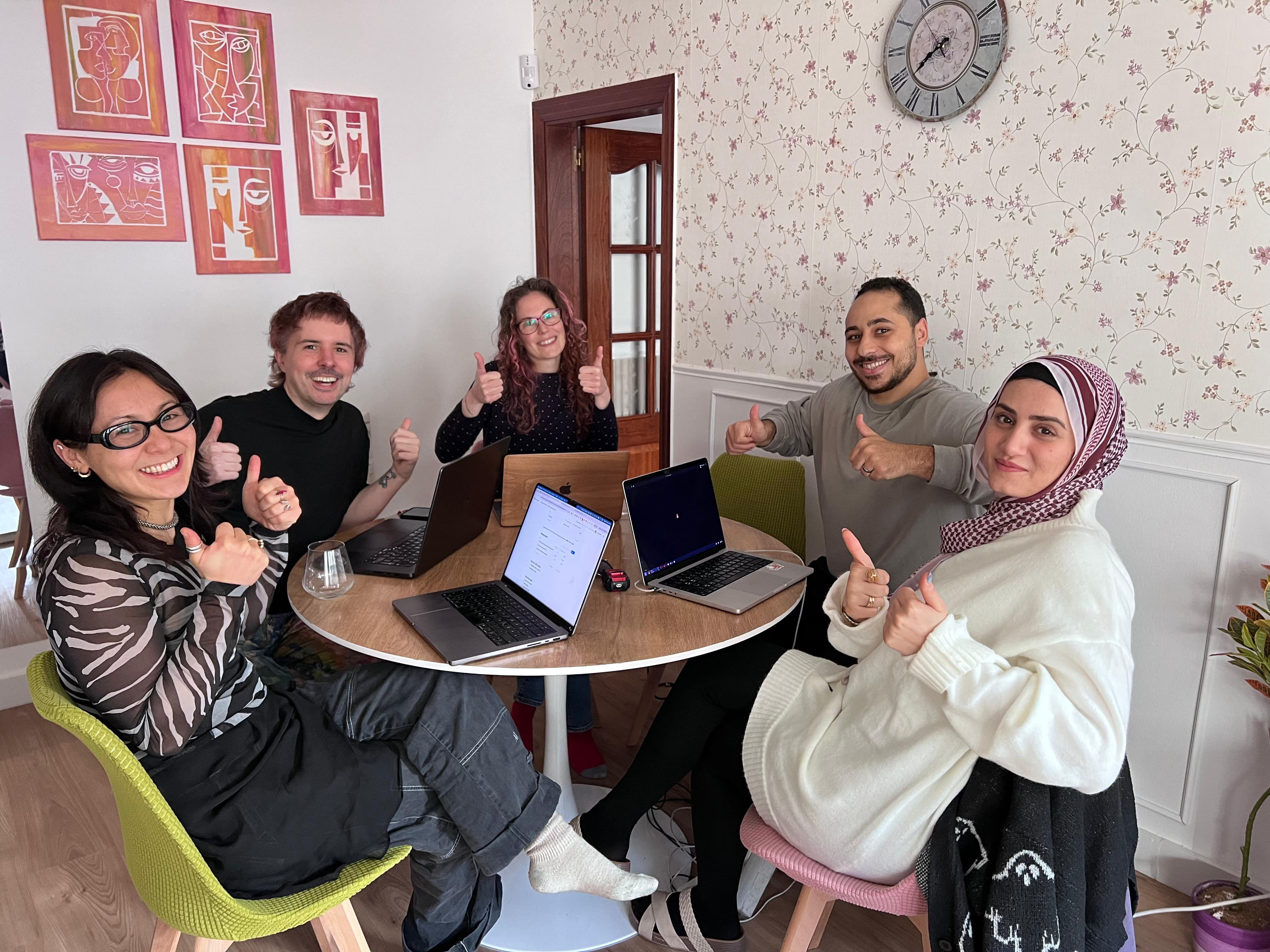


Meanwhile, our colleagues in Gaza were being bombed, displaced, and silenced. We knew we had to build something where Palestinians speak for themselves.
Today, Gaza Living Story holds over 300 stories, each one written by a Palestinian, in their own words.
Who we Are

Yalla is a worker cooperative based in the UK. We build technology for social justice organisations, tools that amplify unheard voices and support communities that are often spoken about rather than listened to.
Around half of our team is Palestinian, and we have always been proud of our Palestinian roots. But from the beginning, Yalla was never built as a charity or as an identity project. It was built as a place where people from different places work together, with equitable opportunities, and with a shared belief that we can imagine and build a better future together.
That balance has always mattered to us. People on our team are here because of what they want to do and how they want to do it. Leadership, responsibility, and trust are based on skill, care, and commitment.
As Joe, our co-founder, put it:
"Rami leads technical work not because he is Palestinian, but because he is really good at what he does. That matters. Leadership based on skill and responsibility is not seperate from social justice. it is part of it."
The Question
Over time, we began asking ourselves a difficult question.
Whilst much of our work supports organisations and communities in the UK, how do we give something back directly to the Palestinian community, in a way that is meaningful and aligned with how we already work?
- Not charity.
- Not representation.
- But voice, ownership, and agency.
What changed After October 7
In the months after October 7, 2023, this question became urgent. Two of our team members, Farah and Ibrahim, shared their shock at watching the world talk about them while they were being bombarded, not knowing if they would live to see the next day. Their stories were being debated, analysed, and reframed by others as they were still trying to survive. That feeling of having your story taken away from you while you are still alive is deeply violent.
As Joe put it,
British memory of Palestine is very poor. The Nakba ( 1948 genocides & displacement) is either misunderstood or not understood at all. That gap in memory is not neutral. It shapes how people think today, what they accept, and what they are willing to ignore. Gaza Living Story is not about correcting history textbooks. It is about changing who gets to speak, and who gets believed.
Gaza Living Story
This is how Gaza Living Story began to take shape.
For generations, Palestinians have carried stories of love, loss, and resistance, woven into their homes, their streets, and their soil. Today, Gaza faces a relentless attempt to erase its people, culture, and history. Yet memory endures.
Gaza Living Story is a digital map of memory, imagination, and hope. It is a living space where Palestinians preserve the past, speak the present, and imagine the future of their land. A space where memories, voices, and dreams come together.
A place where global citizens interested in the history and significance of Palestinian identity can learn about how our culture, people, and will to survive have been forged by our land.
We began the project in July 2025, partnering with Muslim Aid. Development started in the middle of ongoing bombardment, with some of our team working from Gaza itself.
Building It
Israa is one of the main developers who worked on Gaza Living Story from inside Gaza. When she joined the project, she felt the weight of it immediately.
I felt the heaviness of needing to deliver something that carries a Palestinian message. This was one of the first projects I returned to while there was heavy bombardment. But I felt this is where I can contribute. This is where I can do more.
She spoke about what makes the places on the map meaningful.
A lot of the places in Gaza that people know, they see them as normal. But these places shaped me, and shaped a lot of people. They are special for us, even if they look ordinary. I am sure every person in Gaza has a place like this. A place others think is normal, but for us it carries something very special.
In the middle of the project, Israa lost her brother in an Israeli strike. She could have stepped away. Nobody would have questioned it.
But this project was different. I felt it could tell my brother's story, and the stories of others. I decided to continue. I put my energy there. I put my rage there. Continuing the work felt like continuing my life. It felt like I was providing something for my country. People around me were surprised that I kept working, but for me it felt like I was continuing my brother's message - like I was being faithful to him.
Mohammed, another team member, felt a similar pull towards the project, though from a different angle. For him, it was about making sure the story came directly from Palestinians - without filters.
I see this project as a way to communicate how our lives changed in a short time. It is a way to document our grief and how we see things now, after everything we went through. Not just as a record of suffering, but as a first-hand narrative. Without media bias. Without any guidance from someone else.
Erica, the project manager who led implementation, described how working alongside colleagues in Gaza changed how she experienced the work.
It was different knowing my colleagues were living this reality whilst we were building it together. Whilst we were designing the project, I kept thinking about the future. I was not sure if that was more helpful or more depressing. I kept asking myself that. But I always wanted to share it. That feeling never went away.
She paused, then added.
This project is special because it has a direct impact. You can feel it. It is a terrible time, and it does not get better. That is exactly why this project feels important.
The Launch
The team completed the project, having lived through everything described above. On October 14, 2025, we launched Gaza Living Story at Theatro Technis in London, in partnership with Muslim Aid.
The room was full.
Palestinians from Gaza joined virtually to share their memories, their experiences, and their visions for the reconstruction and renewal of their homeland. They spoke directly, in their own voices.
The audience listened.
The launch came at a moment when outside actors were once again looking to shape the future of Palestine and its people, deciding on behalf of a population denied self-determination for generations.
Gaza Living Story was our answer to that.
Not a plan made for Palestinians, but a platform made by them.

Since Then
Since the launch, over 300 stories have been shared on the map.
Some remember the past, places, and routines that no longer exist.
Some document the present, what they are living through now.
Some imagine the future, what they want Gaza to become.
As Israa put it:
We are living in hope, in all the different circumstances we are going through. Without hope, we will die from the inside. Hope is the only thing that makes you want the next day to be better. It is important that we write Palestinian history. It is important that we say what we want, as Palestinians. This is Gaza Living Story.
These stories live at gazalivingstory.org
Written by Lina and Joe on behalf of the Yalla team. This article was created with the support and collaboration of Momus Media.
As part of this collaboration, Momus Media supported the production of this piece and its wider publication. The original version was published in Dutch by Momus Media, while this platform makes the article available in English and Arabic to reach broader audiences.
You can read the original Dutch publication here
Watch this short video where I share my quick thoughts on this article